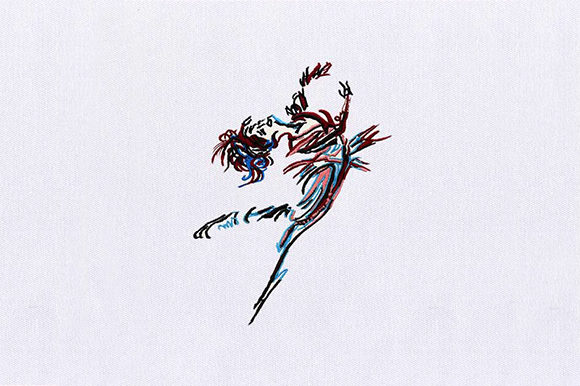
Ballerina Art Brush Embroidery Review
First Impression: Elegant, Playful, and Professionally Balanced
As an embroidery designer who’s developed hundreds of commercial designs for small businesses—from florists to yoga studios—I immediately recognized Ballerina Art Brush as a strong candidate for branded merchandise. The name alone suggests movement, artistry, and grace—qualities that resonate across creative industries. It’s not overly literal (no tutus or pointe shoes), but rather evokes the expressive flow of brushstrokes fused with ballet’s poise. That duality makes it surprisingly versatile: elegant enough for a boutique bakery’s aprons, playful enough for a children’s dance studio’s tote bags, and refined enough to serve as a chest logo on staff uniforms at a local art supply shop.
Real-World Business Use: Where Ballerina Art Brush Shines
In my recent work with a handmade ceramics studio, I tested Ballerina Art Brush as a 2.5-inch embroidered patch sewn onto linen aprons and cotton tote bags. It performed beautifully—not just aesthetically, but functionally. The design scaled cleanly down to 1.75 inches for cap fronts without losing legibility, and its open negative space allowed breathability on textured fabrics like canvas and twill. For a floral café launching seasonal merch, we used it as a sleeve detail on denim jackets and as a subtle corner accent on kraft paper product packaging tags—reinforcing brand identity without overwhelming the handmade product.
It works especially well in contexts where soft professionalism matters: front-of-house staff at creative studios, gift shop employees, or instructors at community arts centers. As a machine embroidery design, Ballerina Art Brush avoids excessive stitch density, which means lower thread breakage during high-volume production and better durability through repeated laundering—a key consideration for apron embroidery and custom apparel used daily.
Careful Application Zones: Know When to Scale Back
While Ballerina Art Brush is highly adaptable, it does require thoughtful placement. On curved surfaces—like the front panel of a structured baseball cap—the outermost flourishes may distort if digitized without contour compensation. Always request or verify a cap-optimized version from your digitizer before mass production. Similarly, avoid using it smaller than 1.5 inches unless you’ve tested the embroidery file on your target fabric: fine details (like delicate brush-tip tapering) can blur on dark uniforms or heavy stabilizer combinations.
Thread color contrast is critical. A light gray or cream thread on navy twill looks sophisticated—but only if the stitch density supports clean edge definition. On highly textured fabric like bouclé or thick corduroy, consider simplifying outlines or requesting a low-density variant. And never assume compatibility with stretch knits; test first with proper cutaway stabilizer and reduced tension settings.
Brand Identity Impact: More Than Just Decoration
Ballerina Art Brush strengthens brand identity by signaling intentionality—not just “we added embroidery,” but “we chose something expressive, skilled, and human-made.” That nuance builds customer trust, especially for Etsy sellers and craft-based businesses where perceived authenticity directly influences purchase decisions. When stitched on reusable tote bags or ceramic workshop aprons, it elevates perceived product value. Customers don’t just see a logo—they register craftsmanship, care, and visual consistency across touchpoints.
I’ve seen clients report higher engagement when Ballerina Art Brush appears across multiple assets: as a chest logo on staff shirts, a woven label alternative on product tags, and a subtle watermark in printable mockups shared on social media. That cross-platform cohesion reinforces recognition faster than standalone graphics—and because it’s rooted in the Dance category without being cliché, it stands out in saturated markets like wellness studios or indie bookshops.
Practical Designer Notes for Small Business Production
Before committing to bulk runs, follow these steps:
- Test in black and white first—this reveals spacing issues and outline clarity that color can mask;
- Check minimum viable size—verify how Ballerina Art Brush reads at 1.5” and 2” on your target fabric;
- Review thread color contrast—especially against dark or variegated textiles;
- Inspect spacing between elements—tight loops or overlapping strokes may cause nesting or puckering;
- Confirm hoop size compatibility—some versions may require larger hoops unsuitable for cap frames;
- Test on real fabric with correct stabilizer—don’t rely solely on digital previews;
- Create a physical mockup for client approval—a stitched sample builds confidence faster than any screen image;
- Compare beside existing design assets—ensure visual harmony with fonts, icons, or other embroidery files;
- Confirm commercial licensing—verify the digital embroidery file permits use on merchandise sold to end customers.
Remember: even a “high-quality embroidery for your next sewing project” needs context-specific validation. What works on a sampler won’t always translate to a polyester performance shirt—or a linen tea towel meant for weekly washing.
Final Thought: A Smart Asset for Creative Small Businesses
Ballerina Art Brush isn’t just another dance-themed embroidery—it’s a strategic visual asset. Its balance of artistry and restraint makes it ideal for small business merch that must communicate warmth, skill, and distinction without shouting. Whether you’re an embroidery shop digitizing for local clients, an Etsy seller building cohesive branding, or a craft studio launching limited-run apparel, this machine embroidery design delivers versatility, wearability, and quiet sophistication. Just treat it like the professional tool it is: test rigorously, scale thoughtfully, and align it intentionally with your broader brand story.